

Going Under, Coming Up
Theophany, rebirth and the future of the Abbey

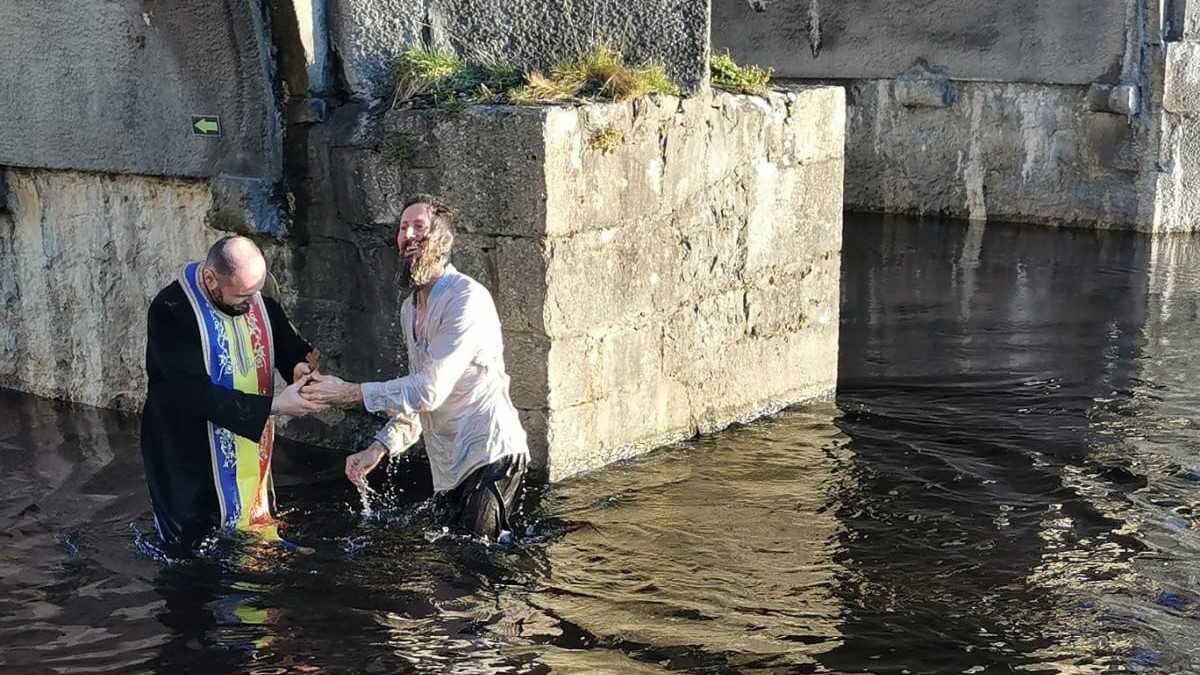
Five years ago today, I was baptised. It was an icy cold day, the ground covered in hoar frost, and I was due to walk in to the River Shannon to be reborn. The covid pandemic was raging, and officially we probably shouldn’t even have been outside, but one reason I chose to enter the Orthodox church is that they have their priorities right. Christ comes first: everything else then falls into place.
So I went under the water three times, and when I came out I was an Orthodox Christian, swimming in a stream of wisdom and truth that is two millennia old. I came out unable to speak, for reasons both spiritual and physical. A dip in the Shannon in January will generally do that to you.
I could say a lot about what has happened since then - I have said a lot on this Substack - but I could also say nothing and it would perhaps mean as much. Words have their uses and their limits. God is not heard in whirlwind or thunder, but as a still, small voice. The Father does not shout, and neither did the Son. I am sure sometimes that God is light and silence, of a quality that down here we can only intuit, or sometimes barely touch, and even that renders us silent as well, if not blind and astounded for years.
In fact, this is how Orthodox tradition has long understood the experience of God. St Sophrony of Essex wrote about how he had been granted a vision of what the Eastern Church calls the ‘Uncreated Light’ of God in his final book, We Shall See Him As He Is. ‘The soul feels apprehensive at approaching the subject of the Light which visits the man who craves to behold the Face of the Eternal’, he wrote. ‘Quiet and gentle, it draws heart and mind to itself, until the earth is forgotten, one’s spirit caught up into another sphere ... your attention is drawn deep within the inner man, into the heart burning with a love now compassionate, now grateful ... Aches and pains disappear. Earthly cares fade away. Anxieties are absorbed into a sweet peace.’
When you are knocked into silence, everything begins anew. This happened to me five years ago, and it will be working its way through me for the rest of my life. When you invite Christ into your heart and ask him to get to work, he begins steadily and at his own pace, and you find that you are not a family home which needs a few superficial bits of work done - a bit of paint here, a new bath there - but a creaking old mansion whose very foundations need stabilising before the rest of the job can even be contemplated. A complete overhaul is required. This old thing doesn’t even have a damp course, and it turns out it was built on sand.
More recently, as regular readers will know, I have been knocked into silence by something else: illness. Long-term overwork has led to a season of deep fatigue and burnout which, in retrospect, has been coming for years. Since mid-October I have been dealing with brain fog, physical exhaustion and any number of physical and mental symptoms of a brutalised nervous system. I haven’t worked, or done much at all, for three months. How long this will last, I don’t know. I have been dosing myself up with herbs and somatic exercises and the Jesus Prayer and the healing oil of St Nektarios of Aegina, and it has all been doing me good. I am still not well, but I am better than I was. It has taken me days to write this essay, but I couldn’t even have written the words six weeks ago. This currently counts as progress.
Chronic illness is the story of the Machine age, and so much of it seems to be related to the way we twist our bodies and minds out of shape to keep up with the demands of a deeply unnatural system. This is what has happened to me, and I can see now that when I come out of the other side of this, however long that takes, I will not be the same person who went in.
To which I can only say: Hallelujah.
Long-term illness, like baptism, is a form of rebirth. All of the saints in the Christian tradition speak to this reality, again and again. ‘It is absurd’, declared St Anthony the Great, ‘to be grateful to doctors who give us bitter and unpleasant medicines to cure our bodies, and yet to be ungrateful to God for what appears to us to be harsh, not grasping that all we encounter is for our benefit and in accordance with His providence.’
How could sickness be ‘providential’? It is hard to think of a notion that is likely to meet with more mockery or confusion in today’s world. But the Christian understanding has always been that illness can serve a purpose. Suffering changes you. Sickness knocks you down. Pride becomes harder when you’re largely useless to the world. I have been a Christian for years now, but I have never felt closer to Christ than I have these past three months. One thing that this faith teaches, again and again, is that everything comes from God, that we are dependent upon Him for everything. We do not make the world, or change it, independently of the force which created and guides it in some fashion we cannot ever really understand.
We know this, but probably we don’t really believe it. Not, at any rate, until we are knocked onto our arses. Only then do we understand what all this talk is about. Some of us - the really obtuse ones - seem to need more of a knock than others. I used to think that people who receive powerful spiritual visions do so as a result of their great holiness. Sometimes this is clearly true, but the opposite is often the case too. My name saint, Paul the apostle, was knocked onto his arse on the Road to Damascus, blinded and humiliated, his whole world turned upside down. Was he a holy man? Not at that point. He was a prideful man, persecuting Christ and his disciples, and refusing to see any of the signs that had been scattered about him. His stiff-necked refusal to listen obviously required a more direct approach. God had plans for Saul the persecutor, but first he needed to be knocked down and opened up. Some of us are like that - maybe most of us. We’re not really paying attention, because we’re too wrapped up in ourselves.
Sometimes, prayer can be dangerous. St Paisios the Athonite taught that you should only ever ask for one thing in prayer: to be taught how to repent. On occasion, maybe foolishly, I have asked something else. I have said: change me, make me any shape you like, make me an actual Christian. But if you give permission in this way, the response can be unanticipated. God’s wisdom is foolishness to the world, after all. The supposedly wise scoff at Him, while only children seem to really understand. The Kingdom of Heaven is probably populated with people who giggle easily, who are fascinated with the precise metallic colour of beetle shells, and who never read any theology.
Illness, then, is a rebirth, and perhaps sometimes the answer to a prayer that you didn’t quite know you had sent up. You ask to be remade - and you get remade. Maybe some of us need to be remade in a way that forces us to become childlike again. I have been reading and thinking too much for too long. I have been overtaxing my left hemisphere in order to make my case about a left-hemisphere dominated society. I have been trying to trust God while worrying overly about the state of His creation. Now I find that I can barely read anything at all, or not for long, and nothing too heavy. I am allergic to ideas, and my brain furiously resists abstractions. I can manage Frog and Toad, but I couldn’t go near the Philokalia. Mind you, both are works of great wisdom in their own way.
Change me, you say, and God says: Well, you asked for it. Then He begins to peel the layers away. You are not being made into something new. Rather, you are being stripped of all the layers of false self that cover up who you once were when you were a child, in spirit and perhaps in body. You can’t be Important in the world if you are sitting in the garden in your pyjamas drinking herbal tea after sleeping for twelve hours. You don’t have the energy to appear on a podcast or to express your Very Important Opinions on the Internet, and nobody really loses out at all.
Speaking of the Internet: since I got ill I have withdrawn further and further from it, and it feels very good. I spent much of the last year on the Internet complaining about technology. One of my readers told me that I had made the mistake of trying to fight the Machine head on. This, he said, is like trying to go to war with the Devil. It will never end well. The best tactic is rather to fight the Machine in ways the Machine does not notice. My friend Martin Shaw tells me that the old myths always recommend this. You don’t look at the Gorgon head on. You need a polished shield before you can deal with her.
I haven’t watched the news, anyway, for months. I have no idea what is ‘going on in the world’ now. Sometimes I glimpse a headline about Keir Starmer or Donald Trump and they seem like dispatches from Mars. I know more these days about the mottled brown cat that keep turning up on my back porch and stalking my favourite robin. The robin is much too smart for the cat. This is the kind of knowledge I had neglected. You should see the combs in my beehive. I’m anticipating my first honey collection if the swarm survives the winter.
No ‘news’ then, and no opinion either. Even coming here to write this feels a bit alien now. We live in a world which has moved almost entirely ‘online’. You realise when you are outside it how, to all intents and purposes, you have resigned from ‘society.’ I have spent the last three months writing prose poems in a little blue notebook; not for publication, just for fun. When your ‘writing career’ is brought to a forcible halt, you find that you can rediscover what made you a writer in the first place: the sheer joy of words. Their use not as tools or an income source, but as lamps to explore the mystery, or toys to play with in the sand. I wish I could do all my future writing in hand-printed chapbooks and give them out on street corners, but my children would quickly starve. Or maybe I’m still not trusting God enough. Jesus instructed us to think like a raven, after all, and I don’t see many ravens wasting their time on Substack.
Half a decade on from my baptism, I sit in the garden under a cold, late-rising winter sun and I can sometimes feel, as I did five years ago today, that my real life is just beginning. I can find myself quite excited to see where all of this is going. I don’t think God will allow me to heal until I have been changed. We’ll see what that means.
For now, though, I need to stop. My head is growing fuzzy again. There are only so many words it can manage in one sitting. Like my namesake, I have a thorn in my flesh now - or perhaps in my brain - and I am learning to give thanks for it. I am waiting to see how it works itself out, and what it leaves behind.
The Future of the Abbey, pt 1: Words
What does all this mean for the future of this Substack, you may be asking? Well, I’ll tell you.
My book Against the Machine, and all of its associated events, podcasts and the like, were the work of many years, and they were also a culmination of the work of decades. I now see that book as the final entry in what I have taken to calling The Machine Quartet. I’m very happy that it’s out there, and that it is connecting with people. But now it’s time to move on.
Even if I was in full health, I would be taking a step back from the limelight this year. Last year was very public for me; this year will be much less so. I will be doing few public events, and even fewer (if any) podcasts and the like. I want to become a writer again, not a public performer. I need to go inwards for a while.
Despite my current state, I have things I want - and need - to do. For a start, I have to finish writing my Book of Wild Saints, which will be published in 2027 by SPCK and Penguin. This is my priority until the summer, and I’ll be taking it steadily. Those stories will also continue appearing here. I would also like to return to writing my Sunday Pilgrimage series: it won’t appear weekly, but will pop up when I can write it. The Monthly Salons will continue, and I have some ideas to spice them up a bit. And when I am able to read properly again, I would also like to resurrect the Scriptorium.
Pilgrimage and story: this is where I expect my writing to go in 2026. Less time looking into screens and spouting, and more entering the woods and inviting the words in. If I have the energy, I would like to make some short pilgrim journeys myself this year, and write about them. Pilgrimage is a very ancient Christian response to sickness; along with nature, it is the great healer. I have things I’d like to say, too, about the great works of Western Christian mysticism, as well as my own continuing explorations of the Eastern Christian tradition. Oh, and I have one final skirmish booked with the Machine before I do anything else. You’ll be hearing about that as soon as I can write it up.
Beyond the Abbey, there are other things brewing. My novel The Wake, which was first published in 2014, is being republished this year by a new publisher in a spanking new edition, so I shall be showing off about that when it happens. And I have a new publishing venture of my own coming up, which I had planned to begin in the second half of the year. I’ll be talking about that as and when it emerges.
The Future of the Abbey, pt 2: Money
All of this, though, is dependent on my state of health, and at the moment that is unpredictable. I am taking things from day to day. I will certainly be continuing to write here - writing is what I do, I am lost without it, and as you can see I am already making (probably too many) plans. What I can’t promise for a while is writing to a regular schedule.
While I continue to recover, I don’t want to give myself the pressure of providing ‘content’ according to some pre-ordained calendar. I’m not an AI, after all. At the same time, neither do I want anyone who has paid for a subscription to feel unhappy about not receiving regular bulletins. With this in mind, I am going to experiment with a new funding model for the Abbey. This is something I was thinking of doing even before I got ill. I have been feeling more and more uncomfortable charging for any Christian content here, and I am also very aware that some people are unable to pay for a subscription at all.
So it’s time for a change. From this point onwards, everything I write here will be free to read for everyone. There will be no paywalls on any of my offerings. However, as I still need to eat and feed my children, I am asking those of you who value what I do here, and who can afford to do so, to consider taking out (or continuing) a paid subscription. This will allow me to continue my work at this uncertain time. It will also mean that your subscription supports those who can’t afford one, and makes my writing free for all.
From now on, there will be three tiers of membership here at the Abbey:
READER. Anyone who wants to read my words here can do so with no payment required, starting today.
MEMBER. Take out a monthly or annual subscription, and you can comment and engage in conversation with the Abbey’s community. You also have access to paywalled content in the archives. Your subscription supports me and my work, and ensures that everyone can read it for free, whatever their means.
FOUNDER. For the very generous or very able, a Founder Member’s subscription gets you all of the above. It also allows you to join in a live conversation with me and other Founders four times a year, and gets you a steep discount on my online writing course. You will also get priority access to any future events I run.
Let’s see how this works out for all of us.
Do have a blessed Theophany (or, for you Orthodox Old Calendarists, a Happy Christmas!) and a hopeful and happy beginning to 2026. I’m profoundly grateful to my thoughtful and engaging community here (with a special shout-out going to all those who have written to me about my illness, offering advice and even sending me gifts - including that healing oil.) I look forward to travelling on with you all in 2026, at whatever speed. Thank you for bearing with me.
Surrounded by precious people who, like myself, some are facing terminal diagnosis, I am amazed at times by their quietness of suffering. The chemo ward gathers us all together from all warps of life and faiths. All of us are facing dying at our own pace- through our own individual processing. The uncertainty for us -and our beloved families-- of not knowing how or when it will happen, is a mountain to climb in terms of acceptance. One thing Paul I can say in terms of illness, is try to glimpse the stillness- it will be within you. I have written on this substack before ...when the minutes are hard, look for the moments. I read this at diagnosis and it has really helped me. God bless you Paul during this time of forced rest. I will pray for you.
I am an old woman who cries easily but it still does not explain why tears started flowing as soon as I started to read this wonderful post. Thank you Paul for your conversion and your integrity. It works.